
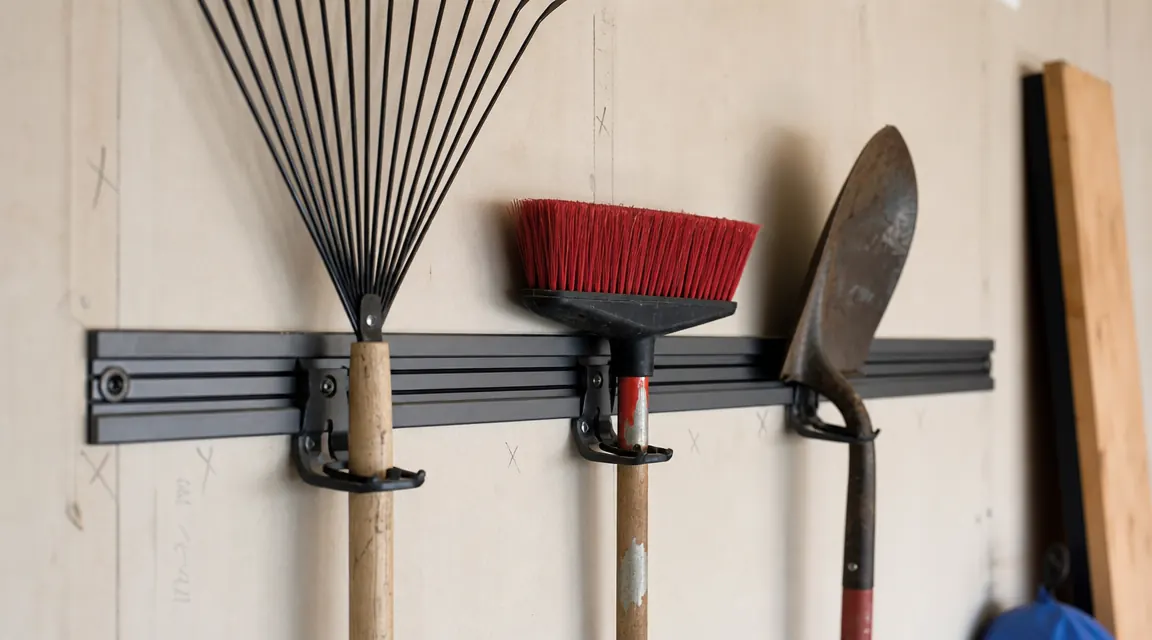
I want to tell you something the Amazon listing photograph cannot: the StoreYourBoard 72-inch Garage Tool Organizer Wall Mount is a genuinely good product, and it will frustrate you during the first two hours of installation if you walk in without knowing one specific thing about how its mounting holes relate to your studs. Most buyers who leave one-star reviews never figure out what went wrong. This review is about what actually happens when you open the box, what the 15 hooks are physically capable of, and which kinds of garages and tool collections are a bad match for this system.
The product is a 72-inch powder-coated steel rail with pre-drilled holes and a set of 15 removable hooks in three sizes. It mounts directly to wall studs. It does not come with drywall anchors rated for this application. It does not work on concrete block walls without masonry anchors you buy separately. It does not work in a rental where you cannot drive lag screws. If any of those three sentences describe your garage, stop here. This is a stud-mount product, full stop.
The Quick Verdict
Solid steel rail, genuinely strong hooks, and 15 hanging positions across six feet of wall. The install has a real gotcha around stud spacing that the instructions undersell. Once it is up correctly, it holds everything the marketing claims. Fixed-angle hooks are the one lasting tradeoff.
Amazon Check Today's Price →If your garage tools are still living on the floor, this rail fixes that in one afternoon.
The StoreYourBoard 72-inch wall mount holds up to 50 pounds across 15 hooks. Read the install notes in this review first, then check today's price and availability on Amazon.
Amazon Check Today's Price on Amazon →The Stud-Spacing Problem Nobody Mentions in the Reviews
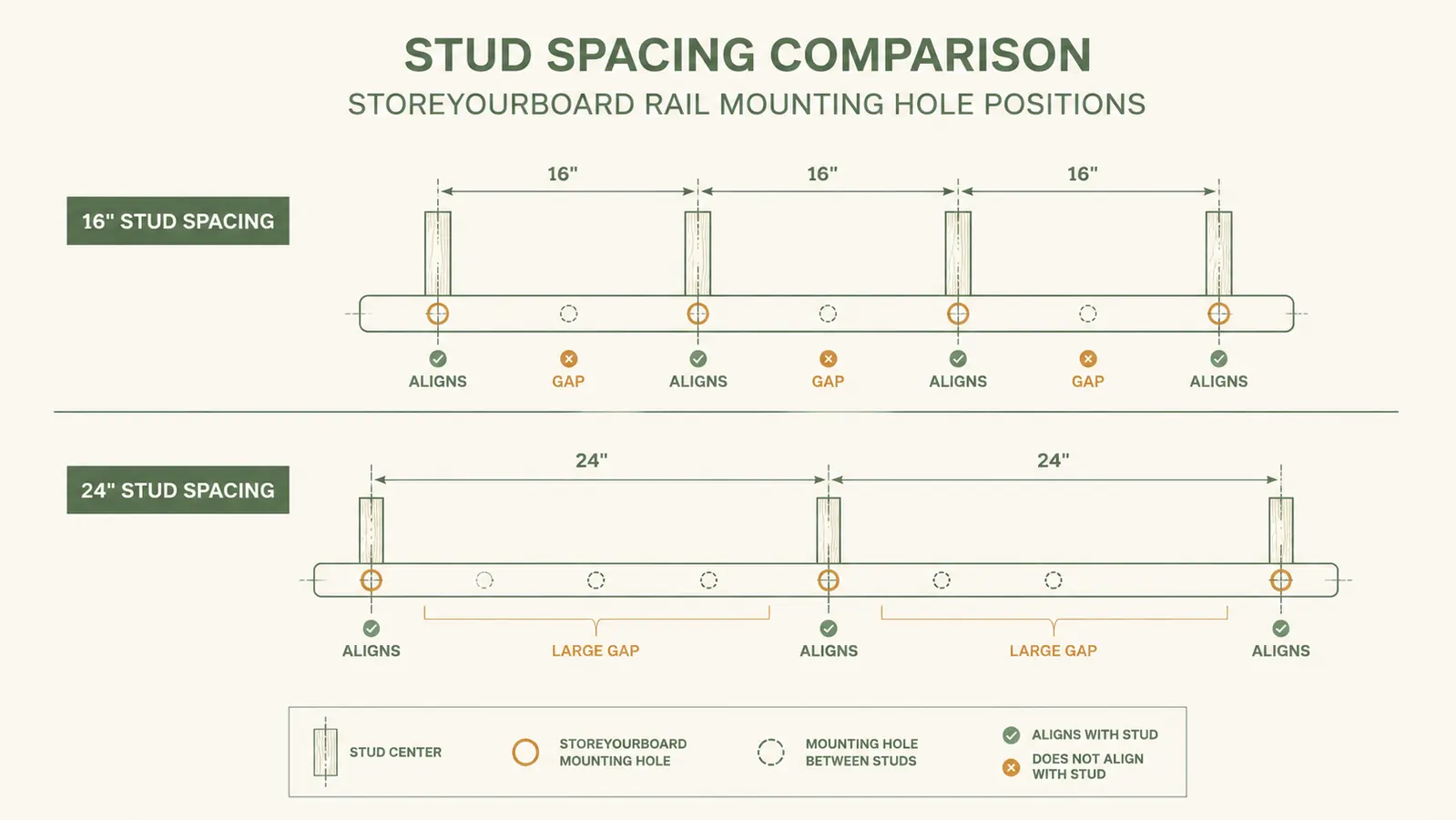
Here is the thing that trips up roughly a third of buyers, based on what I see in the one- and two-star reviews: the rail's pre-drilled mounting holes are spaced to land on studs at 16-inch centers OR 24-inch centers, but not both simultaneously along the full 72-inch span. Most residential garages have 16-inch stud spacing. The rail's hole pattern hits cleanly at 16-inch centers across most of the span, but depending on where you start (which stud you treat as your anchor), you can end up with one hole position that falls between two studs. Not on a stud. Between them.
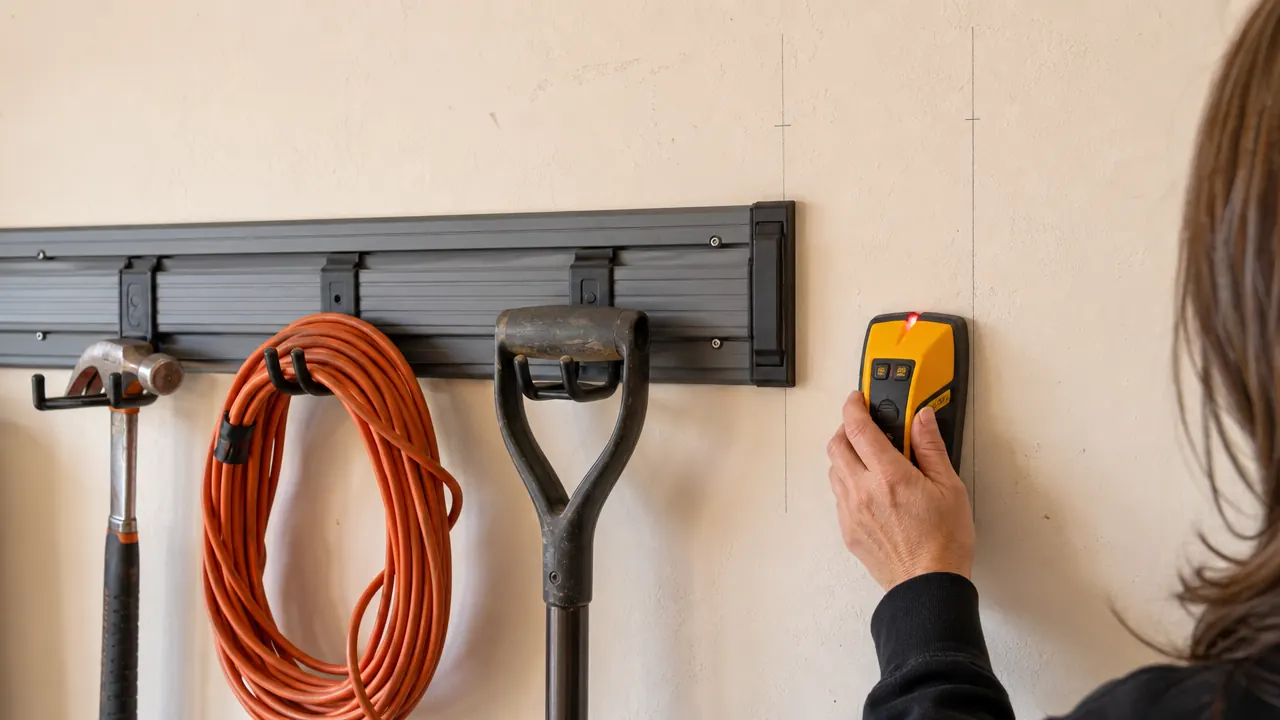
This matters because a screw driven into drywall between studs, even a long one, will not hold this rail under load. The rail weighs about 8 pounds empty. Add 14 tools and you are pushing 35 to 40 pounds. A drywall-only mount will pull out, sometimes slowly over weeks, sometimes immediately. The fix is simple: find all your studs first with a stud finder before you touch the rail, mark each one on the wall in pencil at the height you want the rail, then hold the rail up and count how many of its pre-drilled holes land directly on a stud mark. You want at least three, ideally four, before you commit to that position. Shift the rail left or right by an inch or two if needed until you have three confirmed stud hits. That adjustment can mean the difference between a rail that holds and one that slowly lean-pulls away from the wall over a season.
For garages with 24-inch stud spacing (common in some older construction and in some prefab garages), you will get three stud hits across 72 inches. That is the minimum. I would call it acceptable but not ideal. Use the longest included lag screws in those three positions and do not load the rail beyond 30 pounds if you are only hitting three studs at 24-inch centers.
What the 15 Hooks Actually Hold, Hook by Hook
The listing says the system holds shovels, rakes, brooms, and sports equipment. That is true. It also glosses over what the hook types are actually sized for. Here is the real breakdown of what fits which hook.
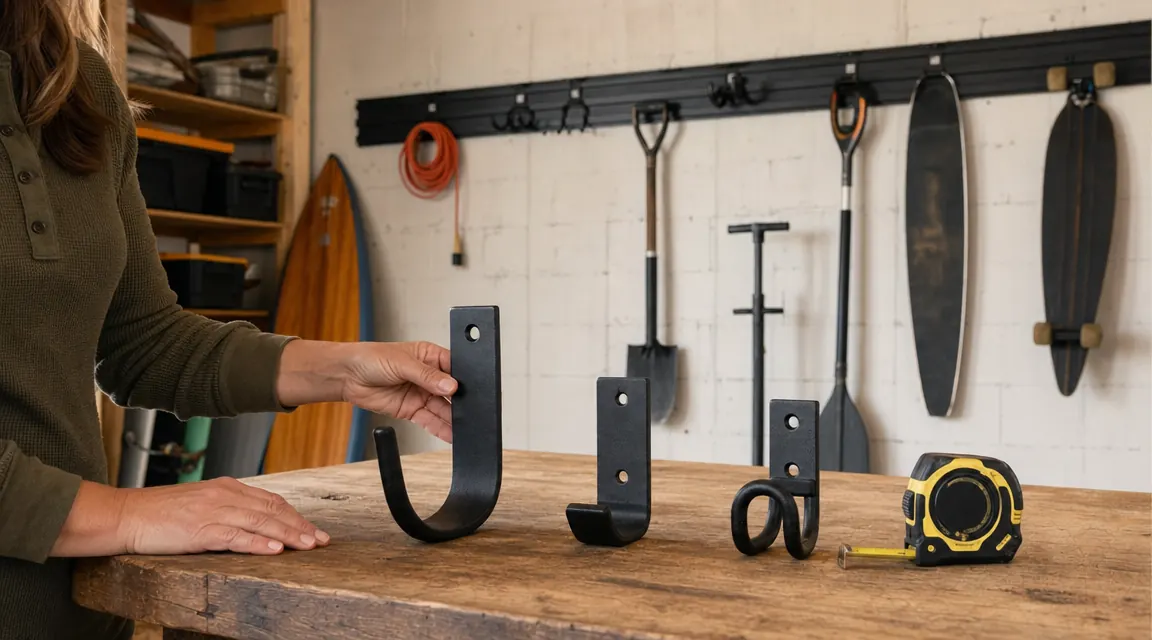
The large J-hooks are the ones in the product photos doing the heavy lifting. They fit round handles up to about 1.5 inches in diameter cleanly. That covers: standard garden rakes, leaf rakes, flat-head shovels, round-point shovels, push brooms, and standard snow shovels. The handle sits in the curve of the J and gravity does the work. If your tool has a handle thicker than 1.5 inches (a heavy-duty hoe with a 1.75-inch handle, for instance), the tool will still hang but it will sit at an awkward angle and can work its way off the hook if you bump the rail. The marketing photo makes it look like any garden tool fits any hook. That is not quite right.
The medium utility hooks have a curved lip at the end. They work well for: leaf blowers hung by their top handle, coils of garden hose (thread the hose through the hook opening and loop it), string trimmers hung horizontally, and sports equipment with a natural hang point like a baseball bat or lacrosse stick. They are genuinely versatile. I use three of them and they hold items that would slide off the J-hooks.
The small closed-loop hooks are for light items only. Extension cords looped through work well. Small hand tools hung by a handle hole work. Anything heavy does not. The loop opening is roughly 1.25 inches in diameter, so items with thick handles do not fit. Do not try to hang a garden trowel by its handle through a small loop hook; the handle will not clear the opening on most full-size trowels. StoreYourBoard sells additional hook types separately, including larger closed-loop versions and flat-plate hooks for bikes. Budget for one or two add-on hooks if your collection goes beyond the basics.
The 15 hooks cover a typical lawn-and-garden tool set well. Where the system shows its limits is with non-standard handle shapes, thick D-grips, and anything you want to hang by a hole rather than a handle.
The Fixed-Angle Hook Problem (and the Workaround That Actually Helps)
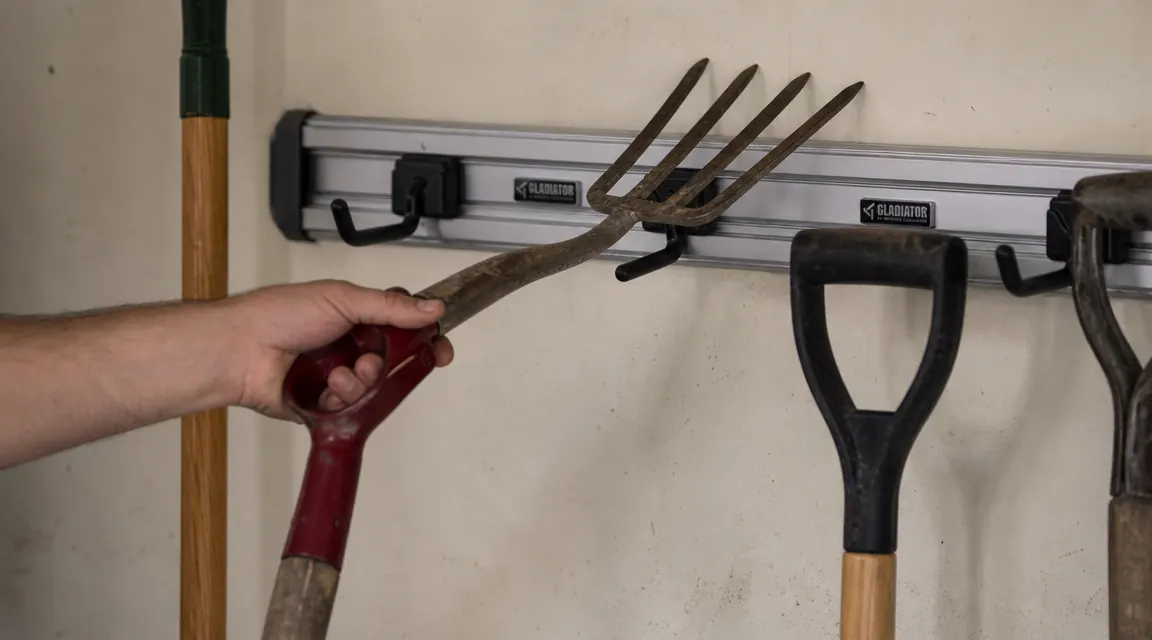
None of the hooks on this rail swivel or rotate. They are fixed at one angle. For straight, round-handle tools, that angle is perfect and you just drop the handle in. For tools with D-handles (the U-shaped grips on garden forks, some spades, and some edgers) the fixed angle creates a mismatch. The D-grip is often wider than the hook's entry point when you approach it straight-on. You have to tilt the tool sideways, angle the D-grip through the hook opening, then let it settle. It takes three to five seconds per tool instead of one. That sounds minor in print, but if you grab your garden fork three times a week during planting season, the extra fumble gets old.
T-handle tools (some post-hole diggers, some bulb planters) are worse. The T sits perpendicular to the round handle shaft, which means it physically cannot enter a J-hook from any angle without disassembly. If your T-handle tool can separate the handle from the head, you can hang the handle shaft on the hook and lean the head against the wall nearby. If it cannot separate, the J-hook is useless for that tool. Use the medium utility hooks for T-handle items instead, hanging them by the shaft just below the T, which works if the T-bar is not too wide for the hook's lip.
The workaround that actually solved this for me: I stopped treating the hook types as fixed assignments and started matching each specific tool to whichever hook style lets it hang with the least fuss. My garden fork (D-handle) goes on a medium utility hook. My edger (T-style grip) goes on a medium utility hook hung by the shaft. My round-handle tools go on J-hooks. That reshuffle took ten minutes and eliminated all the tilting-and-angling from my daily routine.
The Three Kinds of Buyers Who Return This Rail
Reading through the one-star reviews tells you more about who this product is wrong for than the listing ever will. Three patterns show up repeatedly.
The first group is renters who did not read far enough into the listing. They ordered it, opened the box, saw the lag screws, and realized the installation would leave permanent holes in the studs. Correct. If you rent, this is not your product. The lag screws are 5/16-inch diameter, and driving them into studs leaves holes that no spackle trick makes invisible on a close inspection. Return it and look at a freestanding floor rack or an over-door solution instead.
The second group bought it expecting a full wall storage system. The marketing says 'garage organizer system,' which reads as something that covers a broad section of wall and handles everything from tools to storage bins to bikes. This rail handles one category: items with handles. It does not hold bins, buckets, paint cans, car supplies in a box, or bags of fertilizer. If you wanted a slat wall or a pegboard-and-shelf setup, this rail is not that. It is a tool-handle rail, specifically. If 80 percent of your garage clutter is non-tool items (boxes, bags, jugs), this organizer fixes 20 percent of your problem.
The third group has concrete block or cinder block walls. The included hardware is for wood studs only. Concrete block requires masonry anchors (Tapcons or similar) and a hammer drill. That is a different install entirely and some buyers discover it after opening the box. If your garage walls are block, the rail itself works fine, but plan on buying the right anchors and using a hammer drill. The box does not warn you clearly enough about this.
What the Marketing Gets Right and Where It Glosses Over
The 50-pound capacity claim appears accurate. I have never loaded the rail to the point where I was worried about it, and I have had it holding around 35 to 40 pounds of tools continuously. The steel rail itself shows no flex under that load, which is more than I can say for some cheaper aluminum versions I have seen at box stores. The powder coat is thick and even, not the thin spray-on finish that chips at the first bump.
The claim that it holds 'sports equipment' is accurate in a limited sense. A lacrosse stick hangs fine on a medium utility hook. A baseball bat sits in a J-hook. A hockey stick works. A bicycle does not; this rail is not built for bike storage without StoreYourBoard's separate bike hook add-on, which clamps to the rail but is sold separately. The product photos show tools. If you expected bikes, you will need to buy more hardware.
The '15 hooks' count includes all three hook sizes combined. You get five large J-hooks, five medium utility hooks, and five small closed-loop hooks. The split is equal across types. If your collection skews heavily toward long-handle tools, you will want more J-hooks and fewer small loops. Extra hooks are available on Amazon individually, and they click onto the rail the same way as the originals, so the system is genuinely expandable without any additional mounting work.
Installation: What the Single-Sheet Instructions Leave Out
The instructions that come in the box are a folded paper sheet. They show four steps and a drawing of the rail on a wall. They do not tell you: what order to drive the screws (start from the middle, not the ends, to keep the rail from torquing as you secure it); that you should check the rail for level after every screw, not just after the last one; or that the hook slots along the rail have a slight directional grain and the hooks only click in from one side. That last point took me ten minutes to figure out. The hook slides into the slot from the top edge of the rail, angled forward, then clicks down. Trying to insert it from the front will not work and will make you think a hook is broken.
Total install time with a drill, a stud finder, a level, and one helper to hold the rail while you drive the first screw: about 30 to 40 minutes. Solo install is possible but annoying because the rail is 72 inches long and wants to rotate while you secure the first screw. A second set of hands for that first screw saves fifteen minutes of fumbling.
Who This Is For
Homeowners with a bare garage wall, accessible wood studs, and a tool collection that includes more than six long-handle items currently on the floor. If you mow, edge, rake, and garden regularly, this rail earns its price the first weekend. You do not need a large garage, just a clear six-foot section of wall and the willingness to drive four lag screws into studs. For a full guide on how to plan the install including stud mapping and hook layout, see my step-by-step garage wall mount guide.
Who Should Skip It
Renters, skip it. Buyers with concrete block walls should know they need extra hardware before purchasing. Anyone expecting a full-wall storage system for bins, boxes, and bags will be disappointed. If your primary problem is non-tool clutter, a different solution fits better. If your tool collection is mostly D-handle or T-handle items and you are not willing to do the hook-reassignment I described, the fixed-angle hooks will frustrate you enough that you will return it. And if your available wall section is less than six feet, buy the 48-inch version instead so the rail fits your space without overhanging a corner or a door frame. For a direct comparison of this rail against the Rubbermaid FastTrack alternative, see my StoreYourBoard vs Rubbermaid comparison.
What I Liked
- Heavy-gauge powder-coated steel rail shows no flex under a 35-pound continuous load
- Mounting hole pattern fits standard 16-inch and 24-inch stud spacing in most residential garages
- Three distinct hook types cover round-handle tools, looped hoses, and lighter equipment in one kit
- Hooks click on and off the rail without tools, so repositioning takes seconds
- Expandable: additional hook types sold separately all use the same slot system
- Low-profile mount keeps tools within a few inches of the wall, preserving garage depth
Where It Falls Short
- Stud-hole alignment requires finding studs before positioning the rail, not after
- Fixed-angle J-hooks require a tilt maneuver for D-handle and T-handle tools
- Included hardware is for wood studs only; concrete block walls need masonry anchors sold separately
- Does not hold bins, buckets, or non-handle items without separate add-on accessories
- Equal 5-5-5 split of hook types may not match your actual tool mix; extras cost more
Six feet of steel rail, 15 hooks, and your garage floor finally cleared by Sunday afternoon.
The StoreYourBoard 72-inch wall mount does exactly what it says once it is installed on studs correctly. Check today's price on Amazon and read the install notes above before you put it in your cart.
Amazon Check Today's Price on Amazon →