
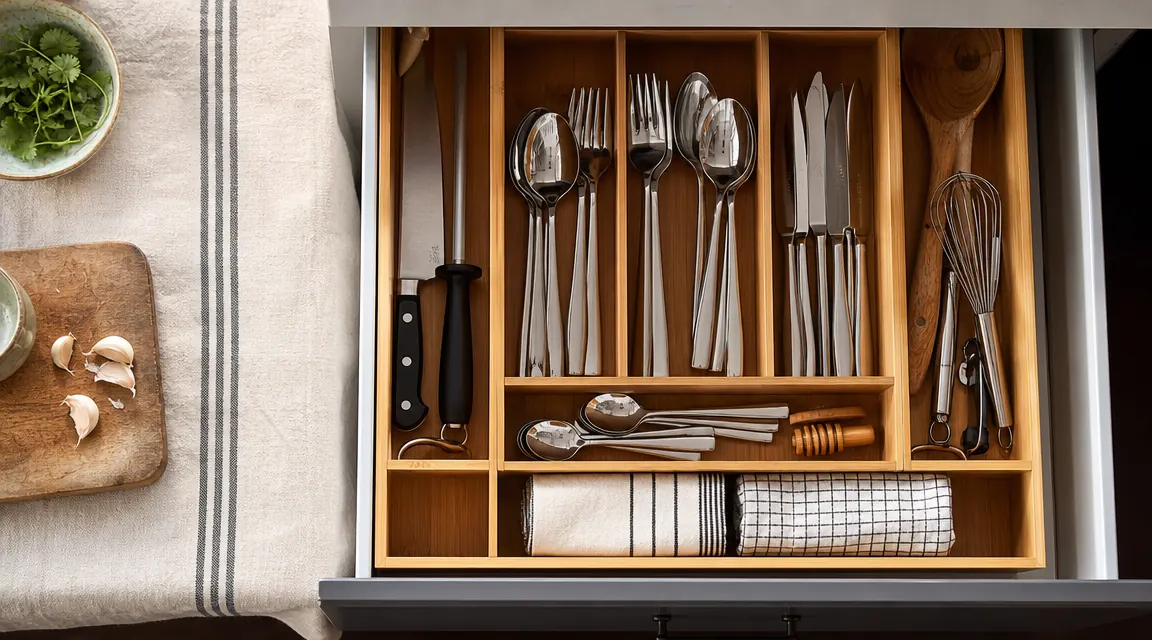
My silverware drawer used to be the most irritating spot in my kitchen. Forks jumbled with rubber spatulas, a meat thermometer rolling loose every time I pulled the drawer open, and a plastic tray that was two inches too short so everything migrated to the back gap. I bought three different organizers before I figured out that the problem was not the products, it was the order I did things. I measured the drawer wrong, sorted nothing before I loaded the tray, and picked a fixed-width tray that did not fit my non-standard drawer. I returned all three. Then I bought the Pipishell expandable bamboo silverware organizer, and I did the steps in the right order this time.
This guide covers exactly how to go from a chaotic junk drawer to a bamboo-divided drawer that stays organized. Not organized for a week and then slowly collapses back. Actually stays organized, because the tray fits, the categories make sense for how you cook, and there is no dead space for things to migrate into. It takes about an hour total, including the measuring and the sorting. You do not need tools, you do not need to drill anything, and this works just as well in a rental apartment as in a house you own.
If your drawer is longer than 13 inches, the Pipishell expands to fit, check today's price before you measure anything else.
The Pipishell bamboo organizer expands from 13 to 19 inches and fits most standard and non-standard kitchen drawer widths. With a 4.7 rating across more than 42,000 reviews, it is the organizer I recommend to anyone who is tired of buying cheap plastic trays that slide around.
Amazon Check Today's Price on Amazon →Step 1: Measure the Drawer Interior Before You Order Anything
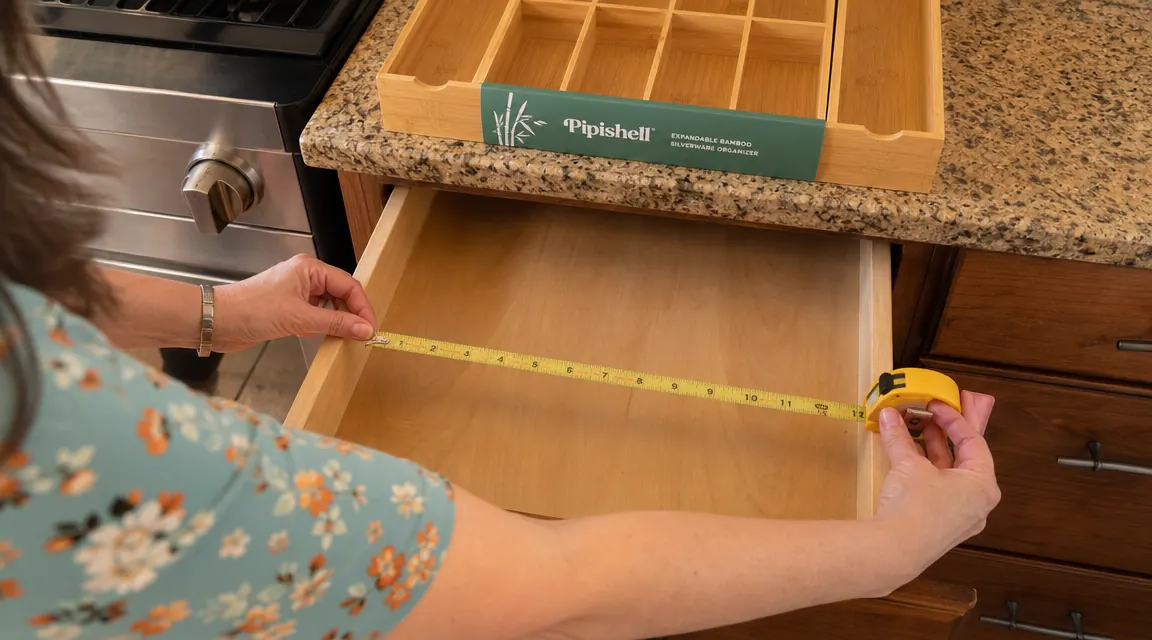
Pull the drawer all the way out and measure the interior width and depth. Interior width means inside the drawer box, not the face of the drawer. I use the lip of a tape measure pressed against one interior side wall and read to the opposite wall. Write down both numbers. Most standard kitchen drawers run 12 to 18 inches wide and 18 to 21 inches deep. The silverware drawer specifically tends to be the shortest drawer in the bank, usually 12 to 15 inches wide.
The Pipishell organizer expands from 13 to 19 inches across, which covers the majority of standard drawer widths. If your drawer measures under 13 inches, this tray will not fit without rattling around. If your drawer is over 19 inches, you have two options: buy two trays and place them side by side, or buy a single longer fixed tray for that drawer. Most renters and homeowners I have talked to fall right in that 13-to-19-inch sweet spot, so the Pipishell handles the drawer without any modification.
Also measure the depth of the drawer opening, meaning how far the drawer slides back. You want at least 12 inches of depth for the tray to sit square. Note any obstructions too, some drawers have a corner support block inside that cuts into usable space. Knowing this before you order saves a return trip.
Step 2: Empty the Drawer Completely and Sort by Category
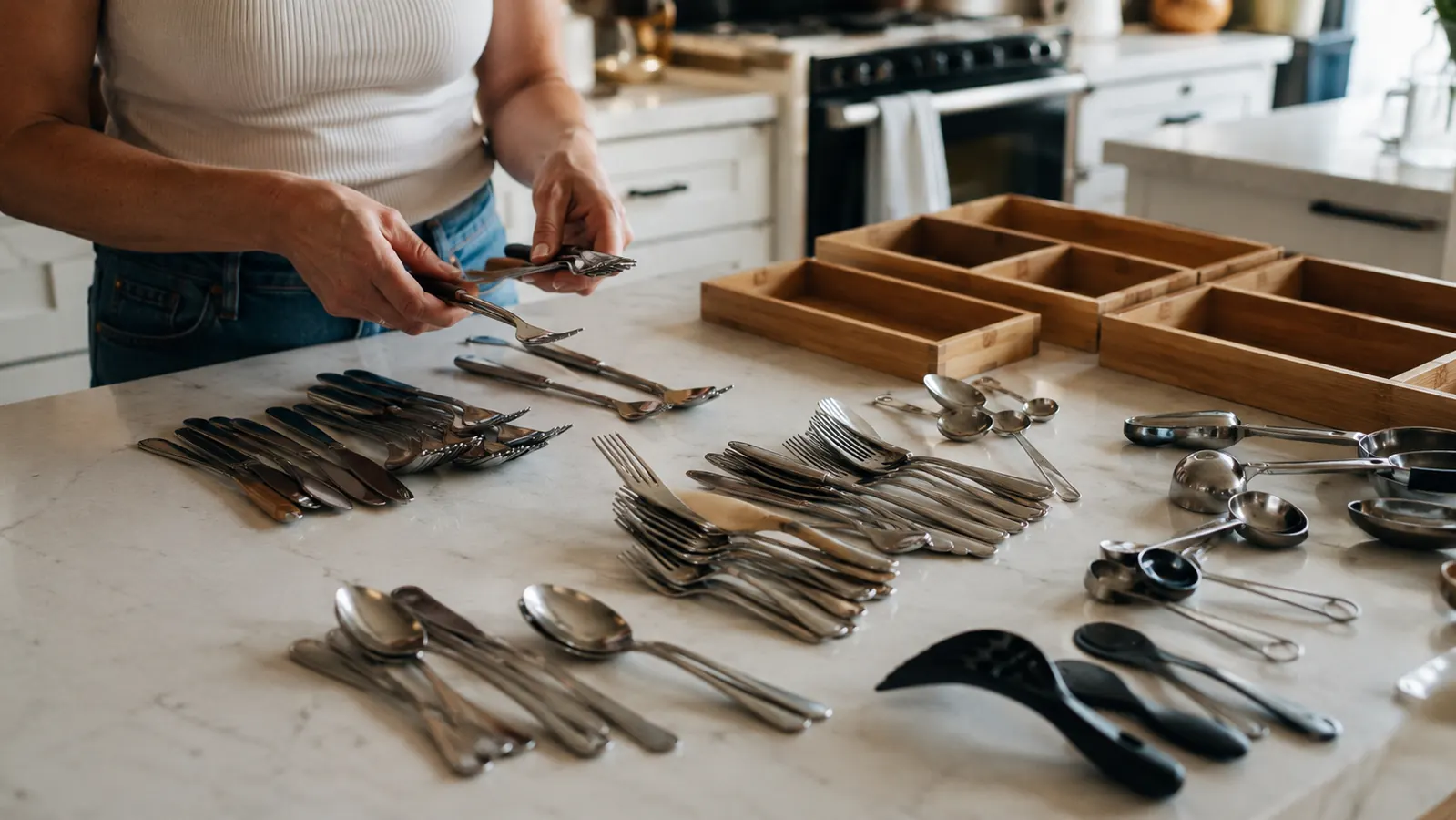
Take everything out and put it on the counter. Every single item. Do not skip this part because it feels unnecessary. You cannot make good decisions about how to divide the drawer until you see everything at once. I sort into basic categories: daily silverware (forks, knives, spoons), serving utensils (large spoons, spatulas, tongs), specialty tools (melon baller, can opener, peeler), and the garbage pile, things that ended up in the drawer by accident and belong somewhere else entirely.
The garbage pile is usually bigger than people expect. I find loose batteries, takeout menus, half a packet of soy sauce, and at least one item I forgot I owned. Get rid of it before you start loading the tray. An organizer is not storage for things you do not use. It is a system for things you use every day, and the system only works if the inventory is honest.
Count how many compartments you actually need. Most people need three to five: one for forks, one for spoons, one for knives, and one or two for everyday utensils like a wooden spoon and a silicone spatula. The Pipishell has five compartments in its default configuration, which covers that range. If you have a lot of specialty tools, consider whether those belong in the silverware drawer at all or in a separate utensil drawer.
Step 3: Expand the Bamboo Tray to Fit the Drawer Snugly
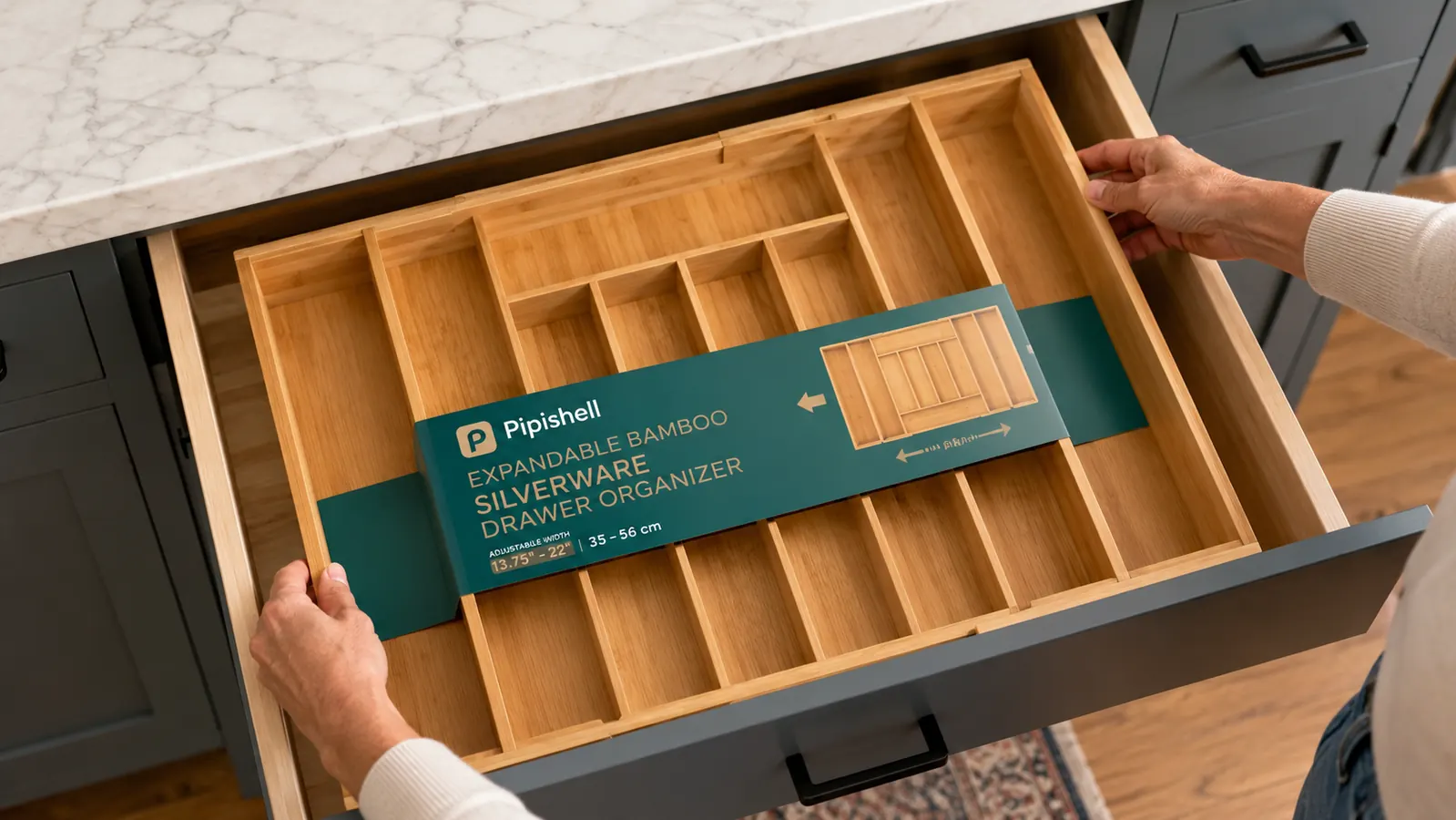
The Pipishell has a sliding extension mechanism on each side. Hold the tray over the open drawer and extend it until the outer edges press lightly against both interior side walls. You want snug, not jammed. If you force it too wide, the bamboo joints can stick and become hard to remove for cleaning. If it is too narrow, it will slide forward every time you open the drawer, and everything inside will shift.
Once you have the right width, lower the tray into the drawer. Push it all the way to the back wall. The tray should sit flat on the drawer bottom with no rocking. If one corner lifts, the drawer bottom is warped slightly, which happens in older rental kitchens. A thin felt pad under the low corner fixes this without any permanent modification. The bamboo surface does not slide the way smooth plastic does, so friction between the tray and drawer bottom naturally keeps it in place.
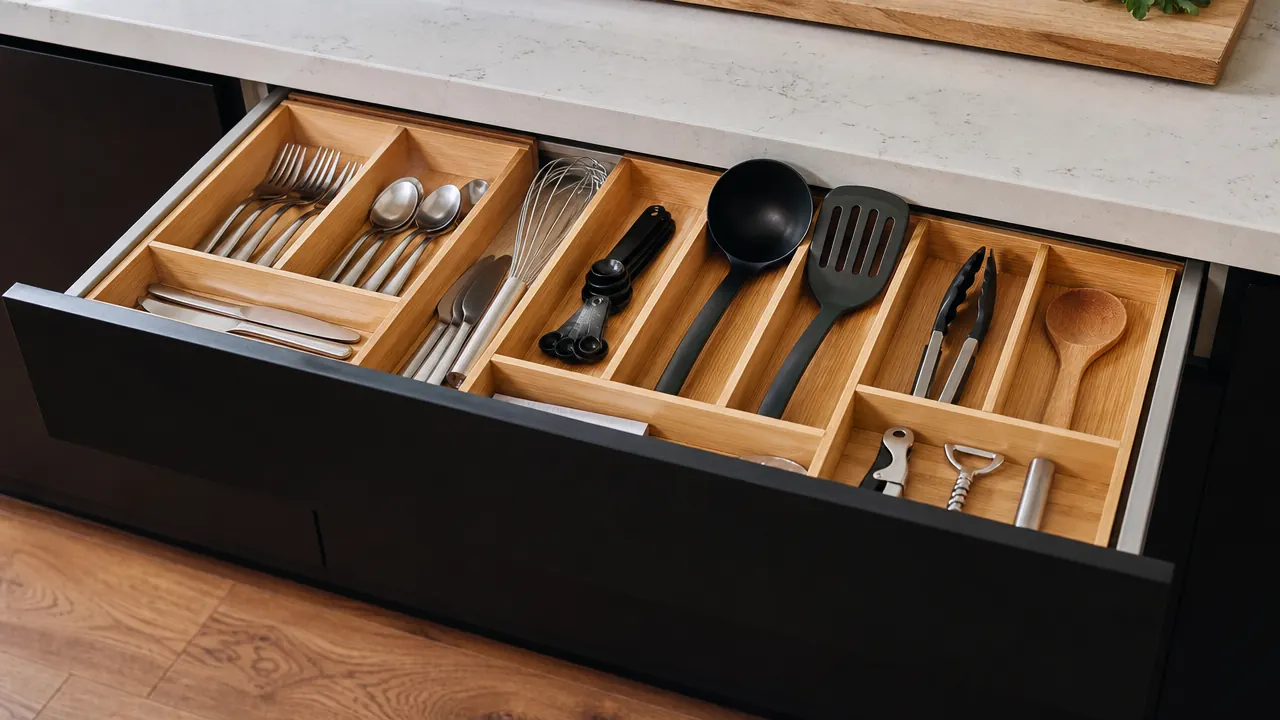
Step 4: Load by Frequency, Tallest Items Toward the Back
Put the things you reach for most often in the compartments closest to the front of the drawer. For most households that means everyday forks and spoons in the front two slots. Items you use a few times a week, like a peeler or a can opener, go in the middle. Things you use occasionally, like a basting brush or cocktail spoons, go in the back compartment.
Taller items and longer utensils go in the back half of the tray wherever the drawer is deepest. A wooden spoon standing upright is not going to fit under the drawer above it, so lay it horizontal across the back. The Pipishell's back compartment is wide enough to hold two or three cooking spoons laid flat, which is usually sufficient for a regular family kitchen.
Be ruthless about what stays in the drawer. If a utensil does not get used at least twice a month, it does not earn a slot in the everyday drawer. The value of the bamboo divider is not just the visual order, it is that it forces you to keep the inventory honest. Every slot is accounted for, and there is no overflow space where random items can accumulate.
Loading the tray is not just about where things fit. It is about where you actually reach first when you are cooking. Front row is for what you grab every single day.
Step 5: Test the Drawer and Reset the System After One Week
Close the drawer slowly and open it again. Everything should stay put. If the tray slides forward when you open the drawer, it is either too narrow or the drawer slides too fast from a worn track. Press the tray firmly against the back wall and extend the width one notch further on each side. Bamboo has enough natural grip that this usually solves the slide problem without anything adhesive.
After a week of real use, open the drawer and look at it honestly. If certain compartments are consistently overloaded while others are empty, adjust. Move the divider spacers if the configuration allows, or swap items between compartments. The Pipishell's compartments are fixed in shape but the tray can be rotated 180 degrees to put a different compartment size at the front. This single adjustment has fixed the layout for me in two different kitchens with different habits.
The one-week check also tells you whether you kept too many items in the drawer. If compartments are still overflowing, pull out the rarely used items and find another home for them, a cabinet, a container on the counter, or the donation box. A bamboo tray in an overstuffed drawer does not solve the problem. It just makes the overflow look neater.
What Else Helps
A good bamboo tray solves the silverware drawer. But if you have other drawers nearby that are still chaotic, a few small habits make the system stick longer. First, commit to a single-drawer rule: if something does not have a home in a specific drawer, it goes on the counter until you decide where it belongs, not back into the organizer drawer as a temporary spot. Second, wipe the bamboo surface with a damp cloth every few weeks. Bamboo can darken if crumbs and grease sit on it too long, and a quick wipe keeps it looking clean. The Pipishell surface is lightly sealed so it does not absorb moisture the way raw bamboo does, which helps. Third, if you have a second drawer of similar width, a utility drawer with batteries, twist ties, and small tools, the Pipishell expands to fit that too. The bamboo works just as well for non-kitchen drawers. I use the same organizer model in my hallway console table drawer for pens, a tape measure, and a small flashlight, and it holds up exactly the same way.
One tray, no drilling, fits drawers from 13 to 19 inches, check today's price and see if it fits yours.
The Pipishell bamboo silverware organizer is the one I keep recommending because the expandable fit means you actually measure once and buy once. No returns, no second-guessing. It works in standard kitchen drawers, wide drawers, and non-kitchen drawers with the same result.
Amazon Check Today's Price on Amazon →